

Understand the actual AI ecosystem and the tools relevant to scientific work and research. This session helps you optimize your workflows with generative AI, delegate and automate repetitive tasks, improve the quality of your papers, and develop AI into a reliable, critical co-thinker rather than a simple chatbot.
Part I can be followed independently. It also serves as the recommended entry point for Part II: Creating Advanced Custom AI Workflows and Tools for Scientists, which builds directly on the concepts introduced here and requires prior participation in Part I.
- Part I : November 13th 2026 from 9:30 to 18:00 at Campus Saint Germain de Prés – Université Paris Cité
- Part II : November 16th 2026 from 9:30 to 18:00 at Campus Saint Germain de Prés – Université Paris Cité (requires second independent registration)

Instructor:
Marin Bogdan, Msc Phyics ETH Zürich
Independent IT consultant specialized in AI, project management and information security
Quality manager and AI lead for Swiss E-Voting, Swiss Post Ltd.
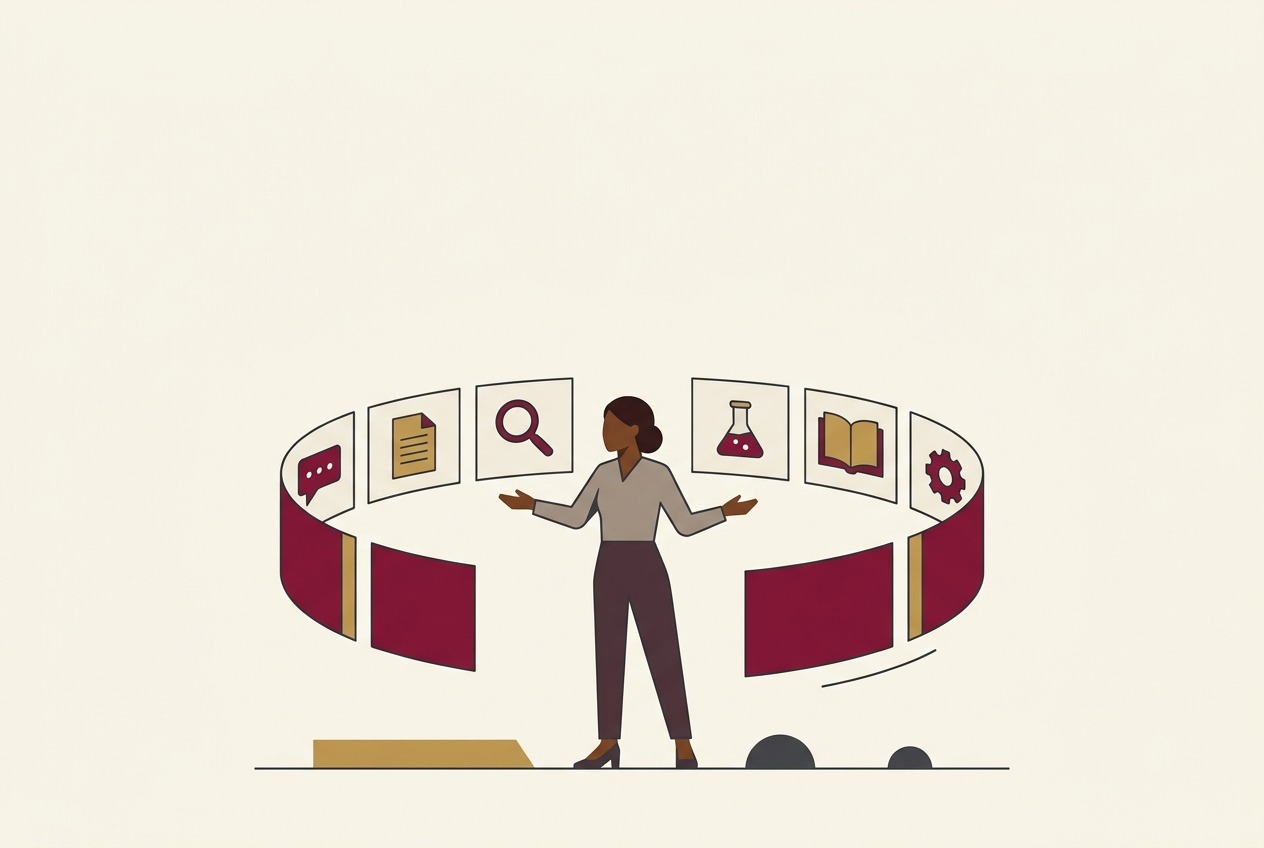
Topics Covered
The AI Ecosystem
Types of AI Tools
This section addresses how to use different categories of AI tools optimally in scientific work. Generic assistants and specialized tools serve different purposes, and understanding which to reach for — and when — makes a measurable difference in both productivity and the quality of your output.
The Big AI Players & Pricing
An overview of the main AI providers in each tool category, along with practical pricing information, so you can make informed decisions about which subscriptions are actually worth adopting for your own work.
Beyond Prompting: Modern Techniques for Using AI Efficiently
AI Workflows in Science: Overview of Claude
This segment surveys the full range of tools within Anthropic’s Claude ecosystem — Claude.ai, Claude Desktop, Claude Cowork, Claude Code, Claude extensions for IDEs, browsers, and office apps, Claude Science, and the Claude API — and how each fits into different scientific workflows. Claude serves as the illustrative case throughout the training, though equivalent tools from other vendors are discussed where relevant.
AI as a Critical Co-thinker, Not Just a Helpful Assistant
This topic moves beyond simple chatbot prompting into context engineering: structuring your interactions with AI to get more reliable results, reduce hallucination, and avoid “context rot” (the degradation of output quality as conversations grow long or unfocused). The goal is to shift the AI’s role from passive responder to active, critical thinking partner.
Data Protection and Legal Requirements
A practical look at how to protect your data and meet legal and institutional requirements when using AI tools — an essential consideration for anyone handling research data, student information, or sensitive materials.
Applied AI Workflows for Your Own Projects
Working with Documents
Hands-on use of Claude Cowork and Claude Code to work directly on your own documents and projects, moving from theory into applied, project-specific practice.
Workflow Automation & Skills
Learn to extend your AI with custom skills so it can apply your expertise and carry out complete workflows on your behalf, rather than responding to isolated prompts. This section introduces Skills, Plugins, Agents, MCP Servers, Automation, Remote Work, Context Management, and Markdown — the same building blocks explored in greater depth in Part II.
Research
Practical use of AI in scientific research: searching the literature, verifying claims, and auditing outputs for accuracy and reliability.
Technical Requirements and recomendations
Attendees must arrive with the following set up in advance:
-
A laptop/notebook computer
-
Free subscriptions to: OpenAI ChatGPT, Anthropic Claude.ai, and Google Gemini (Mistral optional)
-
Desktop versions of ChatGPT and Claude installed
-
Strongly recommended: a Claude Pro subscription (EUR 20/month) or Max subscription for Claude Code
Note: Several requirements or recommendations involve paid subscriptions and multiple software installations. Attendees should anticipate setup time beforehand to avoid delays on the training day. Participation is also possible without a subscription, although hands-on personal practice may be limited. While the workshop uses Claude/Anthropic as the primary illustrative example, it also discusses equivalent alternatives from other vendors.
![[Master Class for Professionals] Beyond Chat: Harnessing the Power of Advanced Language Models in AI](https://biomedical-engineering.u-paris.fr/wp-content/uploads/sites/10/2023/10/recoupee-Illustration-1-1024x1024-1-1017x675.jpg)
[Master Class for Professionals] Beyond Chat: Harnessing the Power of Advanced Language Models in AI
You thought ChatGPT already changed your life? Wait what LLM’s can do for you when used properly! Take this master class in applied AI and learn how to use AI chat models properly and how to easily develop AI applications. Understand the concepts and tools of modern...
![[Master Class ] FabLab Tools for Biomedical Innovation](https://biomedical-engineering.u-paris.fr/wp-content/uploads/sites/10/2023/10/IMG_20230711_163548-1080x675.jpg)
[Master Class ] FabLab Tools for Biomedical Innovation
These master classes will provide an introduction to the necessary skills and knowledge to effectively utilize FabLab tools in biomedical research and engineering projects. The first class, "FabLab Tools for Biomedical Innovation 1: 2D and 3D Design and Fabrication,"...

Biomedical Engineering Master Class for Professionals
The BioMedical Engineerging Graduate School is organizing two master classes for professionals on Wednesday, the 7th of May and 4th of June 2025 . These 2 days are focused on Computational Systems Biology and Network Science in biology and aim to introduce...